Neuralinko
An ai computing server manufacturer designs and builds the hardware behind modern artificial intelligence workloads. These systems combine GPUs, CPUs, high-speed networking, memory, storage, and liquid-cooling components. They are not ordinary office servers. A single rack may contain dense accelerator modules, fiber connections, and cooling pipes that run continuously under heavy computational pressure.
Market demand is rising sharply. Gartner forecast worldwide AI server revenue at approximately $158.6 billion in 2024, representing nearly 100% annual growth. IDC also reported that global spending on AI infrastructure could reach $154 billion during the same year. These figures show strong investment, but they do not tell the whole story. Performance, energy use, supply stability, and service support matter just as much as purchase price.
NVIDIA founder and CEO Jensen Huang said at Computex 2024, “The next industrial revolution has begun.” His statement reflects the wider shift from experimental AI projects toward production-scale computing. An ai computing server manufacturer must therefore provide more than fast processors. It must validate thermal designs, integrate reliable firmware, support demanding software environments, and help customers expand without major downtime. Some product claims still deserve careful examination. Faster hardware does not automatically create better business results. Power consumption, workload compatibility, maintenance access, and total ownership cost can change the final decision. This article examines how these manufacturers operate, which technologies define their systems, and what buyers should evaluate before selecting a supplier.
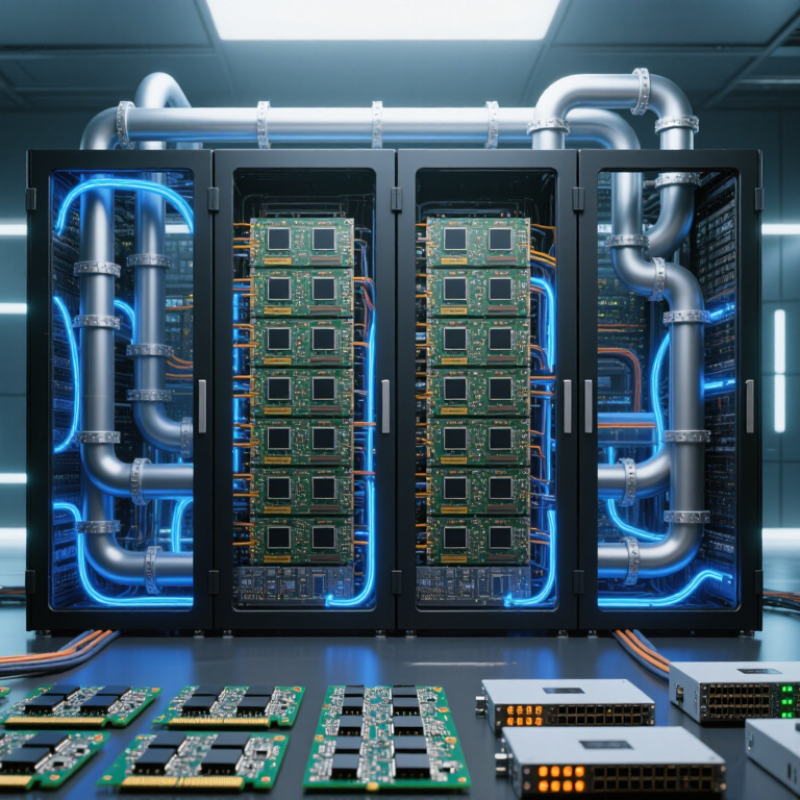
An AI computing server manufacturer designs, assembles, and tests servers for machine-learning workloads. These systems combine processors, accelerators, memory, storage, networking, power delivery, and cooling in a validated platform. The role goes beyond fitting parts into a chassis. Components must work together under sustained load, when heat, power draw, and data movement can limit performance.
A capable manufacturer turns workload requirements into practical configurations. Model training may need several accelerators, high-bandwidth memory, and fast links between servers; inference may prioritize predictable latency and efficient power use. Manufacturers also qualify firmware, thermal behavior, and service procedures, then provide deployment and maintenance documentation. Small details matter: airflow direction, rack depth, connector placement, and access for replacing parts can affect data-center operations. No server is magic. Performance depends on software, workload, and facility conditions, so reliable specifications explain their assumptions rather than promise universal results. Some figures still look cleaner on paper than in a crowded rack. Buyers can compare tested configurations, support coverage, and upgrade paths alongside peak accelerator counts.
An AI computing server manufacturer combines accelerators, memory, networking, power systems, and cooling into a reliable platform. Accelerator chips perform parallel calculations, while high-bandwidth memory keeps model data close to the processors. High-speed interconnects link multiple servers, reducing delays when they exchange large training workloads. Power supplies and voltage regulators must deliver stable current under sudden load changes. Cooling systems then move heat away from dense processor trays.
The International Energy Agency’s Energy and AI report estimates that data centres used about 415 terawatt-hours of electricity in 2024. It projects consumption could reach roughly 945 terawatt-hours by 2030. That pressure makes energy efficiency a core production decision, not a finishing touch. Manufacturers test airflow, component temperatures, firmware, and workload performance together. Small details matter. A poorly placed cable can obstruct airflow; an optimistic benchmark can hide thermal throttling. Peak scores do not guarantee dependable operation.
Tip: Ask for workload-based power and temperature results, not just processor specifications. Check whether the test reflects sustained use. A short test may miss heat buildup, and that’s easy to overlook. During evaluation, compare performance per watt and confirm that cooling remains stable across the full server configuration.
An AI computing server manufacturer turns demanding workloads into a system that can run reliably. Design begins with the model’s needs: training, inference, or both. Engineers select processors, accelerators, memory, storage, and network components to match those tasks. They also plan for future upgrades, since a configuration that works today may become limiting as models grow. Heat is the constraint. Power use and airflow shape the chassis layout, fan placement, and cooling approach. A small clearance around a component can affect temperatures under sustained load.
During production, technicians install components, connect power and data cables, and check that parts are seated securely. The server then goes through firmware setup, diagnostics, and workload testing. Engineers may monitor temperatures, fan speeds, and accelerator performance while running sustained computing tasks. This can reveal issues that a brief startup check misses. No design is perfect; balancing noise, cost, service access, and cooling often means accepting trade-offs. A tidy cable layout helps, but it does not replace careful testing.
Tips: Ask how the system was tested under continuous load, not just at startup. Check airflow requirements, power capacity, and room for maintenance before choosing a configuration. Small details matter. A blocked intake grille or poorly routed cable can make servicing harder.
Illustrative accelerator power scaling at 700 W per accelerator
The bars show accelerator rated power only: the accelerator count multiplied by 700 W. Server manufacturers use this load as one input when designing power delivery and cooling; CPUs, memory, networking, and other components add to the complete system’s power needs. Actual accelerator ratings vary by model.
An AI computing server manufacturer provides more than a chassis filled with processors. Its product range may include GPU servers for model training, CPU-based systems for data preparation, and storage servers for large datasets. Configurations vary in accelerator count, memory capacity, network speed, and power draw. Those details shape performance and operating costs. Details matter.
Manufacturers also offer configuration advice, hardware integration, firmware updates, testing, and technical support. Before shipment, a system may undergo load testing to check temperatures, power stability, and component behavior. Some providers help install servers in racks or plan cooling and power requirements. A useful service team explains trade-offs clearly, rather than treating the largest configuration as the best choice. A dense chassis can save rack space but make maintenance harder. Even careful testing cannot predict every facility’s airflow. Cooling matters. Buyers should ask how support works after deployment, including replacement procedures and software compatibility. Specifications help, but cable access, fan noise, and future upgrades deserve attention too. There is no perfect configuration; workload and site conditions can change the answer.
What Is an AI Computing Server Manufacturer?
Standards for Evaluating AI Computing Server Manufacturers
An AI computing server manufacturer designs and builds systems for workloads such as model training and inference. Evaluation should begin with evidence, not glossy specifications. Ask how the manufacturer validates thermal performance under sustained load, not only during a short benchmark. A rack diagram, airflow direction, and measured inlet temperatures can reveal practical design choices.
Hardware compatibility matters. Check supported accelerator configurations, memory capacity, network bandwidth, and power delivery against your planned workload. Request test results using comparable software and batch sizes. Useful reports show utilization, error rates, and performance over hours, not just peak speed. Look closely at service procedures, spare-part availability, and firmware update practices. Downtime is expensive.
Reliability also depends on integration. A well-designed server should fit existing power, cooling, security, and monitoring systems without awkward workarounds. Ask for clear warranty terms and escalation paths, then speak with technical staff who understand deployment details. Their answers should be specific. Vague answers are a warning. Still, treat benchmarks cautiously: workloads change, and published results rarely capture every site’s constraints. A small pilot can expose noise, heat, cabling, or management issues before a full installation.
An AI computing server manufacturer designs, integrates, validates, and supports server systems built for workloads such as model training and inference. The benchmarks below are a suggested evaluation framework; exact requirements depend on workload, facility, and deployment scale.
| Evaluation dimension | What to assess | Suggested screening benchmark | Evidence to request | Weight |
|---|---|---|---|---|
| Compute and accelerator configuration | Ability to configure CPU, accelerator, memory, and storage resources for the intended training or inference workload. | Published, workload-matched configurations with documented component compatibility and upgrade limits. | System specifications, validated configurations, and a bill of materials for the proposed system. | 18% |
| Interconnect and data movement | GPU-to-GPU, server-to-server, and storage networking capabilities, including bandwidth, topology, and expansion options. | Topology and link speeds are specified; performance is measured using relevant communication and workload benchmarks. | Network diagrams, interface specifications, and reproducible benchmark results with test conditions. | 14% |
| Thermal and power engineering | Cooling design, power delivery, thermal monitoring, and compatibility with the data-center environment. | Power draw and cooling requirements are documented under defined operating conditions; design is assessed against applicable facility guidance, such as ASHRAE thermal guidelines. | Thermal and power specifications, acoustic or airflow data where relevant, and sustained-load test results. | 12% |
| System validation and reliability | Pre-shipment testing, fault detection, firmware validation, and processes for tracking component or system failures. | Documented burn-in and functional test procedures; acceptance criteria and defect-handling process are defined before delivery. | Test plans, sample acceptance reports, failure-escalation workflow, and available reliability metrics with stated methodology. | 12% |
| Software and firmware lifecycle | Firmware maintenance, driver and operating-system compatibility, update controls, and change communication. | Supported software combinations and update procedures are published; security and compatibility updates have a defined release process. | Compatibility matrix, release notes, firmware update policy, and documented rollback or recovery procedures. | 10% |
| Security and compliance | Secure boot and firmware protections, vulnerability response, supply-chain controls, and applicable product-safety requirements. | Applicable safety and regulatory requirements are identified for the destination market; security controls and incident-response responsibilities are documented. | Relevant certificates or declarations, security advisories, vulnerability disclosure process, and supply-chain documentation. | 10% |
| Manufacturing and quality management | Production controls, traceability, component inspection, change management, and consistency between validated and shipped systems. | Documented quality processes; ISO 9001 certification may be used as supporting evidence where applicable, but should not replace product-level verification. | Quality-system scope, production test records, serial-level traceability process, and configuration-change controls. | 8% |
| Serviceability and support | Warranty coverage, repair process, spare-parts availability, escalation path, and support coverage for the deployment region. | Response and restoration targets are contractually stated and match operational needs; service levels are verified for the required locations. | Warranty terms, support service-level agreement, escalation contacts, and parts-replacement process. | 6% |
| Deployment and manageability | Rack integration, remote monitoring, inventory visibility, diagnostics, and compatibility with existing data-center operations. | Installation requirements, management interfaces, and operational procedures are documented and can be tested in a representative environment. | Rack and cabling plans, management documentation, monitoring capabilities, and deployment checklist. | 5% |
| Lifecycle and environmental considerations | Product availability period, repairability, end-of-life notices, energy use, and materials or recycling information. | Lifecycle commitments are documented; energy and environmental claims include a stated measurement method and product scope. | Product lifecycle policy, end-of-life notification terms, energy data, and applicable environmental declarations. | 5% |
| Total evaluation weight | 100% | |||
Scoring note: Apply the same evidence requirements to each candidate, validate performance using the target workload, and treat benchmarks as procurement criteria rather than universal industry guarantees.
It should match your needs for model training, inference, or both. Check accelerator, memory, storage, and network capacity.
Heat builds during sustained workloads. A blocked intake grille or tight component clearance can raise temperatures.
Request continuous-load results, not just a startup check. Useful reports include temperatures, fan speeds, utilization, and errors.
Compare supported accelerators, memory capacity, network bandwidth, and power delivery with your planned tasks. Test comparable software and batch sizes.
Confirm room for maintenance, available power, airflow direction, and cooling capacity. A rack diagram can help.
Clear repair steps, spare parts, and update practices can reduce downtime. Ask who handles technical escalations.
No. Results may not match your software, workload, or site conditions. A small pilot can reveal noise, heat, and cabling issues.
It can make airflow and servicing easier, but it cannot replace proper testing. Easy to overlook.
An ai computing server manufacturer designs and produces high-performance systems built to handle demanding artificial intelligence workloads. Its role extends beyond assembling hardware: it brings together processors, accelerators, memory, storage, networking, power delivery, and cooling into reliable platforms for training and running AI models. Manufacturers also consider scalability, energy use, compatibility, and the environments in which servers will operate.
Production involves selecting suitable components, engineering system architecture, testing prototypes, and validating performance, stability, and thermal behavior before products are delivered. Offerings may include rack-mounted servers, configurable computing platforms, integration assistance, maintenance, and technical support. To evaluate a manufacturer, organizations can assess computing performance, system reliability, expandability, power efficiency, quality-control practices, service coverage, and adherence to relevant technical standards. A strong choice balances workload requirements with long-term operating costs and dependable support.
