Neuralinko
Choosing the right edge AI server manufacturer requires more than comparing processor names or attractive product photos. Global buyers need dependable compute, practical deployment experience, and clear technical evidence. An edge server may operate inside a factory cabinet, a retail branch, or a remote energy station. Dust, heat, unstable networks, and limited maintenance staff can quickly expose weak designs.
Jason Andersen, Vice President of Business Line Management at Stratus Technologies, has said, “The edge is where data is created, and it is where decisions are made.” This principle explains why edge AI servers must process data locally, reduce network dependence, and deliver consistent results. A capable edge AI server manufacturer should therefore demonstrate thermal management, industrial reliability, remote monitoring, and support for commonly used AI frameworks. GPU, CPU, memory, storage, and expansion options also deserve careful comparison.
China has become an important manufacturing base for these systems, supported by mature electronics supply chains and flexible engineering teams. However, “best” should not mean the cheapest quotation. Buyers should verify factory quality controls, product testing records, firmware update procedures, warranty terms, and international support channels. Compliance requirements may differ across markets, so product documentation must be reviewed carefully.
No supplier is perfect. Some manufacturers may offer strong hardware but weaker software support. Others may customize quickly but lack long-term service depth. This article compares important selection factors for global buyers, while recognizing that market conditions and technologies change. A careful decision still needs samples, technical validation, and honest communication.
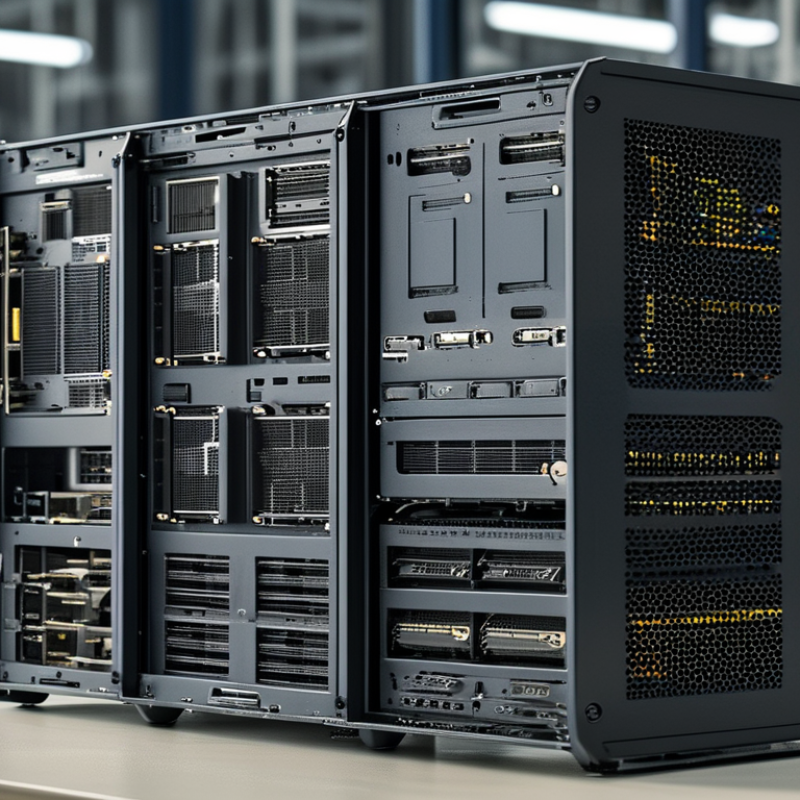
Edge AI servers process data near cameras, machines, vehicles, and sensors. They reduce dependence on distant cloud platforms. This matters when milliseconds affect safety, quality, or customer response.
Gartner forecast that 75% of enterprise-generated data would be created and processed outside traditional data centers by 2025.
That prediction changed how buyers evaluate infrastructure. A factory may inspect products beside a production line. A hospital may analyze medical images within its facility. A logistics center may process thousands of scans without sending every frame away.
An edge AI server usually combines compact computing, GPU or accelerator support, fast storage, and industrial networking. Reliable models also need stable cooling, remote management, encryption, and clear maintenance access. In practical deployments, temperature, dust, vibration, and limited bandwidth can matter more than peak benchmark scores. Buyers should request workload testing with real camera feeds and actual model sizes. The result may be less impressive than a laboratory chart.
The forecast was valuable, but it was not a complete deployment plan. Some companies moved workloads to the edge too quickly. They underestimated software updates, power limits, and local compliance requirements.
A responsible manufacturer should document performance, operating temperatures, component lifecycles, and service procedures. Global buyers also need adaptable configurations, because an airport, factory, and retail site rarely share identical requirements.
Small compromises remain. Reliability often beats maximum speed.
China’s edge AI market is expanding around a massive 5G foundation. Industry figures place the country’s 5G base stations at about 4.25 million by 2024. This infrastructure moves computing closer to cameras, factories, vehicles, and remote facilities. It also creates strong demand for compact edge AI servers with low latency.
For global buyers, server selection should begin with field conditions, not brochures. A reliable system needs stable performance beside dusty production lines or outdoor cabinets. Engineers should examine GPU compatibility, thermal design, power limits, remote management, and storage protection. Short deployment cycles matter too. A delayed replacement can interrupt real-time inspection or traffic analysis.
Numbers can mislead.
A large base-station count does not guarantee every edge project will succeed. My first assumption was that network coverage would solve most latency problems. It does not. Poor cooling, weak software integration, and incomplete testing still create failures. Buyers should request documented stress tests, operating temperature ranges, security controls, and long-term maintenance procedures. They should also test sample units before placing a large order. Experience from pilot deployments often reveals practical issues that specifications hide. The strongest Chinese edge AI server manufacturers combine scalable production with traceable quality control, engineering support, and clear export documentation. That balance helps global buyers build dependable systems for demanding 5G environments.
China Best Edge AI Server Manufacturer for Global Buyers
Edge AI server architecture begins with workload, not a fixed parts list. A CPU manages orchestration, data preparation, virtualization, and system services. GPU resources support parallel inference, video analysis, and demanding model execution. An NPU can reduce power use during repeated AI tasks. The right balance depends on latency, model size, and local operating conditions. More accelerators do not always deliver better results.
Storage needs careful separation. Fast NVMe storage can hold active models and temporary data, while larger drives support logs and datasets. Reliable network design matters equally. High-speed Ethernet reduces transfer delays between cameras, sensors, servers, and cloud platforms. Redundant links can protect operations when one connection fails. In practice, cable paths and airflow are often overlooked. They should not be.
Tips: Test the complete system with real data, not only benchmark figures. Measure inference latency, power draw, temperature, and recovery time. Leave expansion space for memory, storage, and accelerator cards. A compact chassis may look efficient, but restricted airflow can reduce long-term stability. We have seen promising designs fail after dust buildup or uneven workloads. That lesson deserves attention.
Reference architecture and selection data for industrial, retail, transportation, telecom, and smart-city edge deployments
| Architecture Area | Recommended Design | Typical Technical Data | Primary Function | Key Selection Considerations |
|---|---|---|---|---|
| CPU | Server-grade multi-core processor with ECC memory support | 8–64 physical cores; 2.0–4.0 GHz operating range; 64-bit architecture; hardware virtualization support | Operating-system control, preprocessing, orchestration, database services, and general-purpose workloads | Prioritize core count for concurrent services and single-thread performance for low-latency control tasks |
| GPU Accelerator | Discrete parallel accelerator connected through a high-bandwidth expansion bus | 8–80 GB accelerator memory; PCIe Gen4 or Gen5 interface; FP32, FP16, BF16, or INT8 compute support | Large-scale computer vision, video analytics, generative AI inference, and model fine-tuning | Match memory capacity, precision support, thermal design power, and software compatibility to the model size |
| NPU / AI ASIC | Dedicated low-power inference engine for supported neural-network operators | INT8 and INT16 inference are common; performance is workload-dependent and typically specified in TOPS | Always-on inference, object detection, classification, speech processing, and sensor analytics | Verify framework support, operator coverage, quantization tools, model conversion, and driver maturity |
| System Memory | ECC DDR4 or DDR5 memory with sufficient channel population | 32–512 GB typical edge range; higher capacity may be required for multi-stream analytics and large language models | Model loading, buffering, containerized services, feature extraction, and in-memory data processing | Use ECC for improved data integrity; reserve capacity for the operating system, containers, and peak workloads |
| AI Accelerator Memory | High-bandwidth local memory attached directly to the GPU or AI accelerator | Commonly 8–80 GB; capacity determines the maximum model, batch size, and concurrent streams that can run locally | Stores model weights, activation data, and intermediate tensors close to the compute engine | Memory capacity and bandwidth can affect latency more than theoretical compute performance |
| Operating Storage | Industrial or enterprise NVMe solid-state drive with power-loss protection where required | 480 GB–3.84 TB typical; M.2, U.2, or U.3 form factors; PCIe Gen3–Gen5 connectivity | Operating system, containers, inference runtimes, logs, and local application data | Select endurance by write workload; use mirrored boot storage for higher availability |
| Data Storage | Separate high-endurance NVMe or SATA storage pool for video, sensor, and event data | 1–16 TB per node is common; RAID 1 or RAID 10 may be used when local resilience is required | Temporary video retention, data caching, model repositories, and offline operation | Calculate capacity from camera count, bitrate, retention period, compression, and replication policy |
| Network Interface | Multiple Ethernet interfaces separating management, data, and optional storage traffic | 1/2.5/10 GbE for common edge nodes; 25/40/100 GbE for high-throughput aggregation or accelerator clusters | Camera ingestion, northbound cloud connectivity, east-west communication, and remote management | Calculate aggregate ingress, protocol overhead, burst traffic, and uplink redundancy before selecting port speed |
| Network Design | Logical or physical separation of management, workload, storage, and public-facing traffic | VLAN or VRF segmentation; redundant uplinks; optional 802.1Q tagging and 802.1X access control | Reduces congestion, limits lateral movement, and improves operational visibility | Use dedicated management paths and firewall policies for isolated or bandwidth-sensitive deployments |
| Expansion Bus | PCI Express expansion with adequate lanes for accelerators, storage, and network adapters | PCIe Gen4 x16 provides approximately 32 GB/s bidirectional raw bandwidth; PCIe Gen5 x16 approximately doubles that | Connects GPUs, NPUs, NVMe devices, capture cards, and high-speed network adapters | Check lane allocation, slot spacing, NUMA locality, bifurcation, and accelerator power connectors |
| Video and Sensor I/O | Dedicated capture or network ingest interfaces according to camera and sensor protocols | IP video commonly uses H.264 or H.265; interfaces may include Ethernet, USB, serial, CAN, GPIO, or industrial fieldbus | Collects real-time camera, machine, vehicle, and environmental data | Validate codec support, timestamp synchronization, frame rate, resolution, and protocol compatibility |
| Power and Thermal | Efficient power supply, controlled airflow, and accelerator-aware cooling design | Typical node power ranges from about 150 W to over 1,000 W depending on CPU, accelerator count, storage, and fan profile | Maintains performance, reliability, and safe operation in continuous-duty environments | Design for peak—not average—power; consider inlet temperature, dust filtration, acoustic limits, and derating |
| Edge Chassis | Short-depth rack, wall-mount, desktop, or ruggedized enclosure selected for the deployment site | Common formats include 1U–4U rack systems; rugged designs may support wider temperature and vibration ranges | Provides mechanical protection, service access, mounting, and environmental control | Confirm rack depth, shock and vibration requirements, ingress protection, cable clearance, and field-replaceable parts |
| Virtualization and Containers | Containerized inference services with optional virtual machines for legacy applications | Supports service isolation, rolling updates, resource quotas, and accelerator pass-through when enabled by the platform | Simplifies deployment, scaling, monitoring, and lifecycle management at distributed sites | Verify driver, runtime, orchestration, and hardware pass-through compatibility before production rollout |
| Security and Manageability | Hardware root of trust, secure boot, encrypted storage, signed firmware, and out-of-band management | TPM 2.0 support, role-based access, audit logs, remote power control, firmware inventory, and update policies | Protects models and data while enabling remote administration of unattended edge sites | Align controls with local regulations, customer security policies, and offline recovery procedures |
| Reliability and Serviceability | Replaceable fans and drives, watchdog support, health monitoring, and optional redundant power | ECC error reporting, SMART monitoring, temperature sensors, remote alerts, and automatic service restart | Reduces downtime and supports operation at remote or difficult-to-access locations | Define recovery time objectives, spare-part strategy, remote diagnostics, and firmware maintenance windows |
Note: Technical values are representative industry ranges for edge AI server planning. Actual performance depends on model architecture, input resolution, batch size, software optimization, thermal conditions, and workload concurrency.
China Best Edge AI Server Manufacturer for Global Buyers
Manufacturer Evaluation: TOPS, TOPS/W, Latency, MTBF, and Total Cost
Selecting an edge AI server requires more than reading peak TOPS figures. In field testing, sustained TOPS often falls below the advertised level after thermal limits appear. Ask manufacturers for workload results using your model, input size, batch setting, and operating temperature. A short demonstration is not enough.
TOPS/W shows practical efficiency, especially for remote sites with limited power. Request measurements from the complete system, including memory, storage, fans, and networking. Latency should include preprocessing, inference, and output transfer. Review p95 and p99 results, not only average latency. Small delays become serious when cameras monitor fast-moving equipment.
MTBF can support reliability planning, but it is not a guaranteed service life. Check the test standard, temperature range, maintenance assumptions, and component replacement policy. Total cost should include software support, electricity, cooling, spare parts, shipping, and local service. A lower purchase price may create higher operating costs. My own evaluation habit needs improvement: I once focused heavily on TOPS/W and underestimated installation labor. Real deployment evidence matters more than polished specifications.
Comparison of anonymized edge AI server reference configurations using normalized evaluation scores. Higher scores indicate better overall performance, efficiency, reliability, and cost value.
| Reference Configuration | AI Throughput (INT8 TOPS) |
Efficiency (TOPS/W) |
Latency (ms) |
MTBF (hours) |
5-Year TCO (USD) |
|---|---|---|---|---|---|
| Entry Edge | 40 | 1.3 | 18 | 100,000 | 8,200 |
| Balanced Edge | 100 | 2.5 | 11 | 150,000 | 12,600 |
| High Throughput | 240 | 3.0 | 8 | 180,000 | 19,800 |
| Edge Optimized | 80 | 4.0 | 9 | 160,000 | 11,000 |
| Rugged Deployment | 60 | 2.0 | 15 | 250,000 | 15,500 |
The evaluation score uses equal weighting across throughput, power efficiency, latency, reliability, and five-year total cost of ownership. Throughput, efficiency, and MTBF are scored higher when values increase; latency and TCO are scored higher when values decrease. Actual results vary by workload, model precision, cooling design, deployment environment, and service terms.
China Best Edge AI Server Manufacturer for Global Buyers
Global buyers need more than computing performance when selecting an edge AI server manufacturer. Compliance documents, factory controls, and export experience can affect every shipment. A reliable supplier should provide CE and FCC test records for applicable markets. RoHS declarations should also identify restricted substances in major components. These documents need clear model numbers, test dates, and responsible laboratories. Small details matter.
ISO 9001 certification offers useful evidence of controlled production processes. It does not guarantee that every unit will be perfect. Incoming inspection, thermal testing, cable checks, and final burn-in remain essential. Experienced teams should record serial numbers and inspection results before packing. They should also explain any compliance limits honestly. Overpromising creates problems later.
Export support should include commercial invoices, packing lists, product descriptions, and customs data. Protective packaging helps prevent damage during long-distance transport. The supplier should confirm voltage, plug standards, wireless functions, and destination requirements before production. Communication can still fail, especially across languages and time zones. A shared checklist reduces that risk. Buyers may request sample documents and a pilot shipment before placing larger orders. This practical step reveals gaps that polished presentations can hide.
I server?
They support rapid decisions when milliseconds affect safety, quality, or customer response. A factory can inspect products beside its production line.
It commonly includes compact computing, GPU or accelerator support, fast storage, and industrial networking. Cooling and remote management matter too.
Common locations include factories, hospitals, logistics centers, airports, retail sites, and outdoor cabinets. Each site has different conditions.
Buyers should test real camera feeds and actual AI model sizes. They should also examine temperature, power use, storage, and network performance.
No. Laboratory results may not reflect dust, vibration, heat, or limited bandwidth. Field testing reveals more.
A large 5G infrastructure can move connectivity closer to remote equipment and sensors. However, network coverage does not solve every latency problem.
Poor cooling, weak software integration, power limits, and incomplete testing can cause failures. Software updates are easy to underestimate.
They should request remote management, encryption, clear service procedures, and component lifecycle information. Replacement access matters during interruptions.
Not always. Some workloads may remain better suited to centralized systems. The right balance depends on latency, bandwidth, security, and operating conditions.
Choosing the right edge ai server manufacturer is essential for organizations processing data closer to users, devices, and industrial operations. With Gartner’s forecast that 75% of enterprise data could be generated and processed at the edge by 2025, and China’s rapid deployment of more than 4.25 million 5G base stations by 2024, demand for reliable edge computing infrastructure continues to grow. This article explains how edge AI servers support real-time analysis, reduced latency, improved bandwidth efficiency, and distributed intelligent applications.
It also examines the core architecture of an edge AI server, including CPU, GPU, NPU, storage, and network components. Global buyers should evaluate performance through TOPS, TOPS/W, response latency, MTBF, scalability, and total cost of ownership. Compliance with CE, FCC, ISO 9001, and RoHS requirements, together with dependable documentation, logistics, technical support, and export assistance, is equally important when selecting a qualified manufacturing partner.
